3.2 Sustainable dairy
Milk is the most important raw material for the Emmi Group. The Emmi Group understands sustainable dairy to refer to all matters relating to people, animals, the environment and the economy in the context of milk production. Milk production is an important economic factor in rural areas and has a significant impact on animal welfare and the environment.
3.2.1 Impact on the environment and society, and opportunities and risks
As a natural product, milk is a key part of a sustainable nutrition system (Agroscope, Swiss Federal Office for Agriculture, 2017). Natural and characterised by its high nutrient density and high nutritional value, milk contributes to healthy eating.
For the Emmi Group, sustainable milk production means location-appropriate, animal-friendly, climate-friendly and resource-efficient production. Production is adapted to location, especially if the feed is based on the use of grassland and on by-products from food production. This minimises competition for food and land. Feed-food competition occurs when animals use feed that would also be suitable for human consumption. Land competition occurs when the feed comes from land that could have been used to grow food for people. This is particularly critical in areas where food is scarce, as it poses a reputational risk for the Emmi Group. The Emmi Group understands resource efficiency as the efficient use of natural resources (soil/land, water, nutrients and energy). The aim is to achieve the same or even greater output with less input. At the same time, soil and water quality, along with biodiversity, should be preserved. Climate-friendly production refers to the reduction of greenhouse gases.
Two environmental issues are currently dominating criticism of the dairy industry: greenhouse gas emissions and animal welfare. As a milk processor, the Emmi Group has only an indirect influence via the requirements it imposes on its milk suppliers. At the same time, it is exposed to a significant risk to reputation in the event of any misconduct.
On a societal level, the dairy industry provides the income and livelihoods of many people in rural areas. For the Emmi Group, the key social aspects of a sustainable dairy industry are the creation of secure jobs in rural areas, a liveable income that can be generated from work and the maintenance of intact family structures. This is the only way to keep the agricultural sector attractive. A milk price that covers the costs of production plays a key role in this. Should this not be the case in the long term, there is a risk that milk production will decline.
The majority of the company’s shares are held by Central Switzerland Milk Producers (ZMP). This situation means farmers, politicians and the general public have high expectations of the Emmi Group regarding responsible conduct towards its milk suppliers. The Emmi Group’s reputation as a major player in the Swiss dairy industry depends to a large extent on its behaviour.
3.2.2 Management approach and goals
As a milk processor without its own milk production facilities – with the exception of a small goat farm in California – the Emmi Group influences the impact of the dairy industry on the environment and society by selecting its suppliers and managing its opportunities and risks accordingly. By promoting the establishment of sustainable standards and the processing of milk produced in a corresponding manner in all the regions in which it operates, the Emmi Group is helping to gradually make local production systems more sustainable. Through joint projects with suppliers, customers, associations and politicians, the Emmi Group is also driving forward the reduction of Scope 3 greenhouse gas (GHG) emissions.
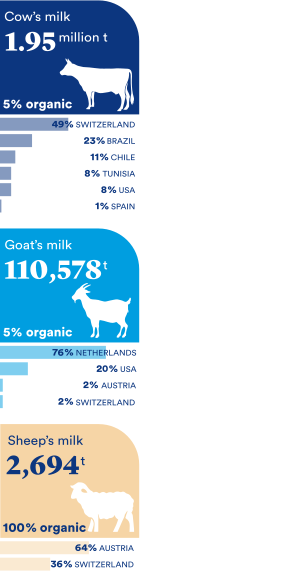
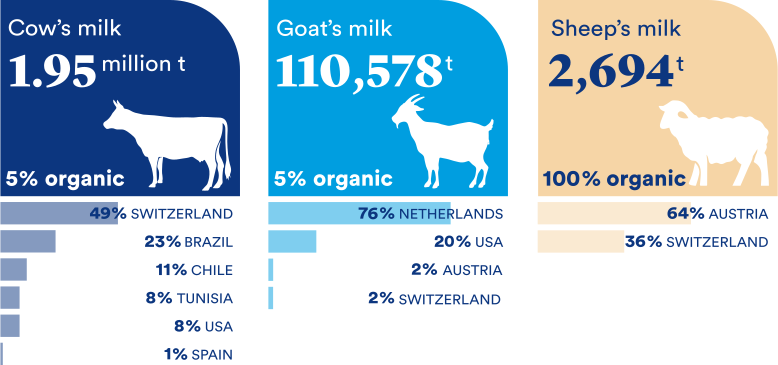
Milk volumes processed by the Emmi Group worldwide (2025)
Taking responsibility across the Group
A focus team consisting of milk buyers and sustainability and agriculture specialists is responsible for implementing the Emmi Group’s sustainable milk strategy and coordinates these activities at Group level. Across the Group, the focus team engages in knowledge sharing and dialogue three times a year, with procurement and sustainability topics increasingly going hand in hand. The Sustainability Steering Committee regularly reviews progress and the achievement of goals.
Moving step by step towards sustainable milk production
As early as in 2016, the company announced its goal of processing milk in Switzerland only in accordance with a defined sustainability standard. This memorandum of understanding triggered a process that lasted several years throughout the industry and led to the creation of the Sustainable Swiss Milk production standard in September 2019. Since 1 January 2024, all Swiss dairy farmers have been obliged to comply with this industry standard.
Since 2024: 100% sustainable milk in Switzerland
Since the start of 2024, only milk produced in accordance with the Sustainable Swiss Milk industry standard has been processed in Switzerland. Ten basic requirements of the standard, which focus on animal welfare, feeding and biodiversity, are mandatory for all Swiss dairy farmers. Dairy farmers must meet at least two freely selectable provisions from the additional requirements, which include social criteria and additional animal welfare requirements, such as social welfare protection for the family members employed on the farm, the training of apprentices or the treatment of animals with complementary medical methods.
The Emmi Group is aware of its shared responsibility for milk producers, particularly in its domestic market in Switzerland. The fact that milk in Switzerland is usually produced by family-owned farms must be considered. This can be achieved through measures such as developing transparent, long-term and predictable partnerships. These include detailed milk invoices, punctual milk payments, planning and supply security – and, last but not least, a mutually acceptable milk price in line with the market. As a member of the Milk industry organisation (BO Milch) – a platform for the Swiss dairy industry – Emmi works in a constructive manner to further develop the Swiss dairy industry and consistently implements the decisions made by this body, such as the agreed guide prices.
Further development of the Swiss industry standard planned
In spring 2024, the Milk industry organisation (BO Milch) decided to take the first step in developing the industry standard further, focussing on climate-related matters. This has led to the development of a standard climate calculator for the industry. This is based on the KLIR climate calculator, which was developed by the Bern University of Applied Sciences School of Agricultural, Forestry and Food Sciences (HAFL) and has been in use for three years as part of the KlimaStaR Milk resource project. This calculator was simplified and improved in the reporting year to ensure broad applicability. The new climate calculator is scheduled to be rolled out in the first quarter of 2026 for the calculation of emissions for 2025 on the basis of the fully available input data.
The climate calculator quantifies the company’s own GHG emissions per kg of milk and shows milk producers which activities cause emissions. The results enable comparisons to be made with similar production sites and form the basis for tailored measures to reduce GHG emissions.
Emmi supports the gradual further development of the Swiss industry standard across the board. The company firmly believes that this will provide a significant competitive advantage for Swiss milk while securing the long-term future of the sector. In addition to the broad-based industry standard, various smaller organisations and sector participants in Switzerland contribute to the operation of a sustainable dairy industry. Through its memberships, the company therefore supports the organisations Kometian and AgroCleanTech: Kometian advises farmers on all aspects of complementary veterinary medicine; AgroCleanTech conveys knowledge about climate protection in agriculture.
The Klimatisch platform for the Swiss meat and dairy industry
The Klimatisch platform was launched in 2023 for the Swiss meat and dairy industry to address the challenge of financing measures, crediting reduced GHG emissions to the various sector participants and accelerating the implementation of emission reduction measures. All stakeholders across the entire value chain work together through the platform. After examining various approaches for the above-mentioned financing of the measures and the creditability of climate protection benefits within the industry, it was decided in 2024 that the measures should be implemented outside the committee within the corporate context. Since then, Klimatisch has focussed primarily on the mutual exchange of experiences and is held three times a year in the form of a face-to-face meeting.
Reduction of Scope 3 GHG emissions in Switzerland: KlimaStaR Milk
The Resource Project for the Promotion of Climate Protection, Site Adaptation and Resource Efficiency in Milk Production (KlimaStaR Milk) aims to strengthen milk producers in their efforts to reduce GHG emissions and adapt their dairy farms to their local environment.
Together with the association Central Switzerland Milk Producers (ZMP), Nestlé and aaremilch, the company has been working since 2022 to reduce GHG emissions and competition between dairy cows and humans for land and food on 222 farms. GHG emissions are recorded using the KLIR climate calculator. Jointly defined indicators are used to calculate direct competition for food and competition from cultivated land in the Swiss dairy industry and optimise resource efficiency.
A total of 85 pilot farms from the KlimaStaR Milk project are going one step further: a holistic model (RISE Sustainability Analysis) is used to analyse ten different areas that influence both the sustainability and the efficiency of a farm. In addition to land use, water management and biodiversity, these also include profitability, working conditions and quality of life.
The initiative is supported by the Federal Office of Agriculture as part of the resources programme (Art. 77a of the Swiss Federal Law on Agriculture) and is supported by HAFL, which acts as a scientific partner.
By 2027 (basis: mean value for the years 2019 to 2021), the dairy farms participating in the KlimaStaR Milk project are expected to achieve the following targets on GHG emissions, feed-food competition and land competition:
- reduction of GHG emissions by 20%
- reduction of feed-food competition by 20%
- reduction of land competition by 20%
Reduction of Scope 3 GHG emissions in Chile and Brazil
In Chile and Brazil, the Emmi Group is likewise pursuing a practice-oriented management approach to reducing its Scope 3 greenhouse gas emissions in milk production. The focus is on working with local milk suppliers to measurably reduce the climate impact of agricultural processes through data collection, analysis and targeted measures, even in regions with different baseline conditions.
First, emissions are systematically recorded on selected pilot farms and the most important levers for reduction are identified, such as in the areas of herd management, feed efficiency and sustainable feed. Based on these outcomes, site-specific reduction plans are then developed and initial measures implemented. The aim is to scale successful approaches and expand them to larger supplier pools in the medium term.
Emmi’s criteria catalogue for milk purchased outside Switzerland
By the end of 2027, the Emmi Group wants to process milk outside Switzerland that is produced only in accordance with a sustainability standard that exceeds the local average. Due to its niche activities in many countries, the Emmi Group relies on commitments within the industry and on individual agreements with its milk suppliers.
The Emmi Group has developed the basis for such agreements over the past five years. Based on a criteria catalogue developed with HAFL, it evaluated eight aspects of sustainable milk: strategy, work and income, milk quality, animal welfare, biodiversity, energy and materials, climate and environment. For example, the following criteria are included in the animal welfare category:
- appropriate stabling for livestock
- regular access to pasture
- optimised feeding
- humane dehorning
- limited transport time to the slaughterhouse
- responsible use of antibiotics
- reasonable productive life per number of lactations
- rearing of offspring on the farm of birth (minimum number of days)
The catalogue contains additional specific criteria for suppliers of goat’s or sheep’s milk. In addition, the following criteria are used to analyse the social sustainability of the Emmi Group’s milk suppliers outside Switzerland in the categories “strategy” and “work and income”:
- plans to ensure that the farm continues to produce milk in ten years’ time
- legally binding employment contracts for salaried employees
- minimum wage for salaried employees
- profitability of the business
The Emmi Group’s objective for 2027 that milk purchased outside Switzerland is produced according to local above-average standards is understood by the company as milk that exceeds conventional milk in at least one aspect of sustainability. In some countries or regions, this already applies to the entire volume of milk processed by the subsidiaries (Austria, the Netherlands, California). In other countries or regions, only part of the processed milk volume (Chile, Wisconsin) currently meets this requirement.
3.2.Developments in the year under review
“Bienestar Animal” certification and pilot project to record GHG emissions in Chile
Quillayes Surlat in Chile has set itself the goal of having all its suppliers certified with the “Bienestar Animal” animal welfare label. Developed by IRTA (Institute of Agrifood Research and Technology) and certified by AENOR, the standard defines the requirements that livestock farms must meet in terms of animal welfare. Twelve different animal welfare criteria are defined within four different areas. The farms are audited annually in accordance with these criteria. Eleven new farms were certified in the reporting year. Seven production sites were excluded because they are no longer suppliers or because certification has been temporarily suspended. At the end of 2025, a total of 84 farms covered 94% of Quillayes Surlat’s milk volume. Quillayes Surlat is the first South American company to purchase milk certified with this animal welfare label. Additional farms are expected to be certified next year.
Furthermore, a pilot project involving 13 farms was initiated in the reporting year to record GHG emissions. These 13 farms cover 27% of the milk volume of Quillayes Surlat. The data collection was completed successfully. The most important levers for reducing emissions were identified: optimisation of feed and efficiency, herd management and the use of sustainable soya. Reduction plans were drawn up for each production site and the reduction measures were initiated.
Pilot project to reduce GHG emissions in Brazil
In summer 2023, Laticínios Porto Alegre started a pilot project with 18 farms to measure GHG emissions on dairy farms and use this as the basis for defining measures to reduce emissions. Baseline data collection was completed in 2024. The following were identified as the most important levers for reducing emissions: herd management, feed efficiency and increased productivity. Building on this, data collection on GHG emissions was expanded to 131 farms in the reporting year.
The Emmi Group measures progress using the following key performance indicators:
|
Milk volumes processed across the entire Group |
|
2025 |
2024 |
2023 |
|
|
Cow’s milk |
t |
1,951,269 |
1,893,542 1) |
1,815,099 1) |
|
|
Goat’s milk |
t |
110,578 |
98,889 1) |
99,176 |
|
|
Sheep’s milk |
t |
2,694 |
2,753 1) |
2,745 |
|
|
Total |
t |
2,064,542 |
1,995,184 1) |
1,917,020 1) |
|
|
|
|
|
|
|
|
|
Organic milk volumes pro- cessed across the entire Group |
|
2025 |
2024 |
2023 |
|
|
Organic cow's milk |
t |
105,573 |
104,964 |
105,742 |
|
|
Organic goat’s milk |
t |
5,641 |
6,444 1) |
6,632 |
|
|
Organic sheep’s milk |
t |
2,694 |
2,753 1) |
2,745 |
|
|
Total |
t |
113,908 |
114,161 1) |
115,119 |
|
|
|
|
|
|
|
|
|
Proportion of "Sustainable Swiss Milk" |
Target 2027 |
2025 |
2024 |
2023 |
Base year 2019 |
|
Percentage of milk volume |
100% |
100% |
100% |
99% |
87% |
|
Percentage of milk suppliers |
100% |
100% |
100% |
99% |
75% |
|
|
|
|
|
|
|
|
Proportion of processed label milk international |
|
2025 |
2024 |
2023 |
|
|
Percentage of label milk international |
|
43% |
39% |
n/a |
|
1) Correction due to revised data and calculation basis.
Methodology for non-financial figures 2025
Fondation Vitalait supports smallholder farmers in Tunisia
Fondation Vitalait is a foundation of the Emmi subsidiary based in Mahdia, Tunisia. It supports small-scale dairy farmers locally to improve their working conditions and income through practical initiatives in the areas of feeding, animal welfare and training. In total, more than 1,000 farmers have already received support from the foundation. In 2025, 65 new farms were added.
Training is a central pillar of the foundation’s work and follows a participatory approach based on the Farm Field School model, which promotes collective learning. These training courses build on from the benchmark survey conducted in 2023 together with the Swiss Agency for Development and Cooperation (SDC). Its goal is to strengthen technical competencies, promote good animal husbandry practices and improve both the productivity of dairy farms and the quality of milk. In 2025, 180 farmers took part in the training, 115 of which focussed specifically on the topic of animal welfare. In addition, the foundation supported a group of 73 farmers as part of a programme to improve raw milk quality and working conditions. In this context, 17 stables were converted into free-range, while eight shading systems and six automatic drinking troughs were installed. These measures contribute to the well-being of the animals as well as to higher work efficiency.
Commitment of suppliers in Spain in the areas of greenhouse gas emissions and biodiversity
The cooperative (Kaiku S. Coop.), from which Kaiku in Spain procures approximately 80% of its milk volume, joined a national alliance of eight dairy cooperatives in the reporting year. The alliance has set itself the goal of reducing GHG emissions by 30% by 2030. In collaboration with Neiker (Basque Institute for Agricultural Research and Development), the cooperative is currently finalising the methodology for calculating the GHG footprint at the farms. A pilot project was launched on 13 farms in 2025. This work is part of the NutriBerri project, which involves measuring the reduction potential of methane emissions through the use of an antimethanogenic component. The cooperative is also a partner in the three-year Dairital project. Under the leadership of the Leartiker technology centre, and with the participation of organisations from France, Portugal and Spain, the project is testing measures to improve sustainability on real agricultural production sites.
The Ramaders cooperative, from which Kaiku purchases the remaining 20% of its milk, has set itself the goal of reducing GHG emissions by 35% by 2030 and improving biodiversity by 15% through defined biodiversity indicators on farms (plant species, habitat quality, presence of pollinators) compared to 2023 baseline values. Measures to reduce GHG emissions include optimised feeding, natural feed additives, manure management, energy and herd management, and an expansion of digitalisation and monitoring. With regard to biodiversity, the focus of the measures is on crop rotation and the use of mixed crops, the preservation of hedges and flower strips, the avoidance of pesticides, rotational grazing and collaboration with local environmental organisations to set up demonstration areas and monitoring.
Aspects in the criteria catalogue
The Emmi Group companies Quillayes Surlat (Chile), Kaiku (Spain), Laticínios Porto Alegre (Brazil) and Vitalait (Tunisia) have applied Emmi’s own criteria catalogue to their milk suppliers. Together, these cover around 84% (2024: 84%) of the total milk volume processed by Emmi Group companies outside Switzerland. Kaiku and Quillayes Surlat have defined the goals for 2027 based on the results of the initial application of the criteria catalogue. Quillayes Surlat focusses on sustainable soy, animal welfare and GHG emissions when working with milk suppliers, while Kaiku has set targets for biodiversity and GHG emissions with its milk suppliers. At Vitalait, the criteria catalogue for assessing the current situation is applied annually, but no targets for improvement have been set in the individual categories. Laticínios Porto Alegre is working to reduce GHG emissions on farms and to develop solutions for sustainable soy.
Determining the international baseline
Evaluating local labels helps to measure the goal of ensuring “100% of the Emmi Group’s milk suppliers worldwide produce according to above-average local standards” outside Switzerland. With the support of HAFL, the Emmi Group assesses the international labels in terms of sustainability using the criteria catalogue and evaluates whether the various labels meet the Group’s targets. According to current findings, 43% of the milk purchased by the Emmi Group outside Switzerland comes with a label that differentiates itself locally from conventional milk.
By contrast, in the international companies with high milk volumes (Laticínios Porto Alegre, Brazil; Quillayes Surlat, Chile; Kaiku, Spain and Vitalait, Tunisia), the criteria catalogue is applied directly to selected milk suppliers. Due to the high milk volume, the Emmi Group aims to create an even more sound basis for setting and pursuing clear goals.
KlimaStaR Milk project
An evaluation of the starting situation from 2019 to 2021 showed that, at 0.857 kg CO2-eq/kg milk, the GHG emissions at the 222 Swiss KlimaStaR farms are almost half as low as assumed based on secondary data (1.45 kg CO2-eq/kg milk). The emissions are also much lower than the secondary data as part of an international comparison. This confirmed the assumption that optimised feeding (e.g. even more grassland-based livestock feeding and the use of high-quality feed or feed additives), herd management and farmyard manure storage are the three decisive factors for reducing the carbon footprint. Through the measures in these areas, the production sites were able to reduce their GHG emissions by 5.9% per kilogram (kg) of milk to 0.806 kg CO2-eq/kg milk (as at 31 March 2025) in the first three years of the project. Despite the reduced use of concentrated feed per cow (-8.3% compared to the baseline), the annual milk yield remained the same. In addition, the use of renewable energy, such as biogas plants and solar energy, contributes to reducing emissions. The goal of reducing feed-food competition by 20% was significantly exceeded by the participating production sites in the first three years of the project (-20.8% compared to the baseline). The goal of reducing land competition by 20% has been more than halfway achieved at the midpoint of the project (-13.4% compared to the baseline).
Retail, agriculture and processing adopt declaration of intent for climate-friendly agriculture in Switzerland
In the reporting year, the members of IG Detailhandel Schweiz (Coop, Denner and Migros) launched the “Klimabündnis Lebensmittel”, in which Emmi Schweiz AG plays an active role. A joint declaration of intent based on five key points was adopted in July 2025. The following objectives are pursued in three broad working groups:
- Emission factors: agreement on uniformly calculated SBTi-compliant emission factors for all relevant raw materials.
- Standardised exchange of data: agreement on a standardised data exchange approach via a neutral platform along the value chain.
- Financing model: development of a financing model that safeguards the source and use of funds and avoids market distortion.
3.2.4 Outlook
By the end of 2027, the Emmi Group wants to process milk outside Switzerland that is produced only in accordance with a sustainability standard that exceeds the local average. However, the global assessment found that it is difficult to measure the achievement of this target due to the challenge of collecting local average data on an international level. The Emmi Group will examine this in depth in future with the goal of developing a more refined methodology and setting more accurate goals (for the new strategy period starting in 2028 at the latest).
In Chile, the Emmi Group seeks to further increase the number of milk suppliers certified with the “Bienestar Animal” animal welfare label in 2026. The annual audits will be continued with the companies that have already been certified. The pilot project for recording and reducing GHG emissions is to be rolled out to additional farms, with the goal of covering 40% of the total milk volume. The plan is for the first pilot group of 13 farms to implement the measures developed to reduce GHG emissions. Furthermore, the focus is on developing solutions for sustainable soya production (see section 3.9 Responsible sourcing).
The Emmi Group will also be focussing on reducing Scope 3 GHG emissions in Brazil. Cooperation will continue with the 131 farmers who have already reported their GHG emissions for the purpose of establishing a solid basis for understanding emissions. In addition, a pilot project to implement reduction measures featuring the involvement of 13 farms is to be initiated.
In Switzerland, the Emmi Group will continue to work actively on the KlimaStaR Milk project and on the industry-wide roll-out of the climate calculator.